

HOA rules are the policies a homeowners association board adopts to govern day-to-day use of property and common areas — parking, pets, noise, landscaping, decorations. They are legally binding from the day you buy in the community. They are also the weakest document your association has: rules rank last behind law, the recorded plat, the CC&Rs, the articles of incorporation, and the bylaws. A rule can never permit what the law forbids, and it can never forbid what a higher document protects.
That single fact settles most HOA disputes. Below: what the rules cover, which ones are unenforceable, how fines actually work, and how to challenge a rule in Washington DC, Maryland, or Virginia.
What Are HOA Rules?
“HOA rules” gets used loosely for three different documents that carry very different weight. Knowing which one you are actually arguing about is the difference between a rule you can challenge and one you cannot.
- The CC&Rs (covenants, conditions and restrictions) are recorded against the land and bind every owner. Changing them takes a supermajority owner vote and a new recording.
- The bylaws govern how the association itself operates — elections, meetings, quorum, officer duties. They change by owner vote.
- The rules and regulations govern daily use. A board adopts, amends, or repeals these on its own, with no owner vote. This is what most people mean by “HOA rules.”
Because rules are the only one of the three a board can change unilaterally, they are where overreach happens — and where they are most often unenforceable.
12 Common HOA Rules
Most associations regulate the same twelve areas. The third column is the one worth reading: it tells you whether the board could impose that restriction on its own, or whether it needed an owner vote.
| Rule category | What it typically covers | Usually set by |
|---|---|---|
| Architectural changes | Additions, decks, windows, roofing, solar panels | CC&Rs + architectural guidelines |
| Exterior paint and materials | Approved color palettes, siding, trim | CC&Rs or rules |
| Landscaping and lawns | Grass height, approved plantings, tree removal | Rules |
| Fences and structures | Height, material, placement, sheds | CC&Rs |
| Parking and vehicles | Guest spaces, commercial vehicles, RVs, street parking | Rules |
| Pets | Number, size limits, leash rules, waste | Rules |
| Noise and nuisance | Quiet hours, construction windows | Rules |
| Trash and exterior storage | Bin placement and timing, visible storage | Rules |
| Signs and decorations | Political signs, holiday displays, flags | Rules, limited by statute |
| Rentals | Minimum lease terms, short-term rental bans, rental caps | CC&Rs |
| Occupancy limits | Number of residents per unit | CC&Rs, limited by fair housing law |
| Common area use | Pool hours, clubhouse booking, guest access | Rules |
Anything marked Rules can change at a single board meeting. Anything marked CC&Rs needs an owner vote and a recording. That gap is why a board that cannot pass a CC&R amendment sometimes tries to reach the same result by adopting a rule instead. That shortcut is the single most common source of an unenforceable HOA rule.
Which Document Wins When HOA Rules Conflict
When two documents say different things, the higher one controls. This is the HOA rules hierarchy, and it decides nearly every dispute.
| # | Document | What it controls | Who can change it |
|---|---|---|---|
| 1 | Federal, state, and local law | Fair housing, safety, zoning, and the state statutes governing associations | Congress, the legislature, the county or city council |
| 2 | Recorded map, plan, or plat | Lot lines, common area boundaries, easements, access | Rarely changed; requires re-recording |
| 3 | Declaration of CC&Rs | Owner rights, assessments, use restrictions, enforcement power | Supermajority owner vote, then recorded |
| 4 | Articles of incorporation | The association’s legal existence, name, and purpose | Owner vote plus a state filing |
| 5 | Bylaws | How the association runs — elections, meetings, quorum, officers | Owner vote |
| 6 | Rules, regulations, resolutions | Day-to-day use — parking, pets, pool hours, landscaping, decor | A board vote, on its own |
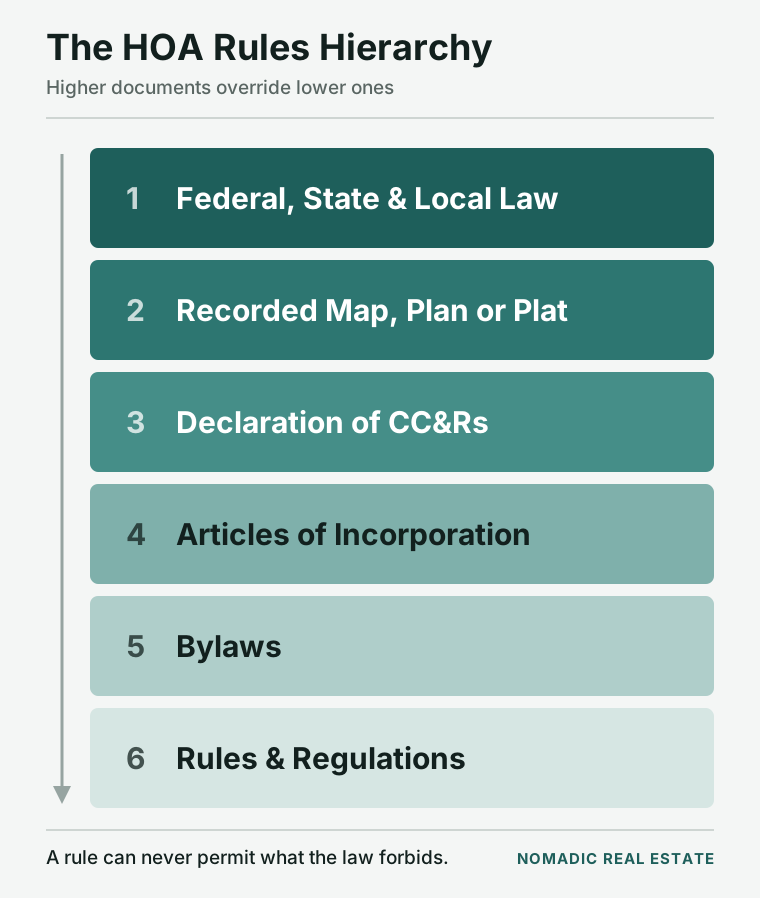
Read it downward. Anything on a lower line that contradicts a higher line is unenforceable to the extent of the conflict — no matter how long the association has been enforcing it.
Unenforceable HOA Rules
Some HOA rules are void the moment they are written, regardless of what the CC&Rs say or how the board voted. These are the eight that come up most often.
| The rule | Why it fails | Source |
|---|---|---|
| Discriminates on race, color, religion, sex, national origin, familial status, or disability | Void outright | Fair Housing Act, 42 U.S.C. § 3601 et seq. |
| Applies a “no pets” policy to an assistance animal | A reasonable accommodation is required | Fair Housing Act |
| Prevents a satellite dish or antenna in an area you exclusively control | Void if it unreasonably delays, raises the cost of, or prevents installation | FCC OTARD rule, 47 C.F.R. § 1.4000 |
| Bans the U.S. flag on your own property | Void; reasonable size and placement limits survive | Freedom to Display the American Flag Act of 2005 |
| Conflicts with a state statute | Unenforceable to the extent of the conflict | e.g. Va. Code § 55.1-1800 et seq. |
| Contradicts the recorded CC&Rs | The declaration controls | The governing document hierarchy |
| Was never properly adopted, noticed, or recorded | No valid rule exists to enforce | The association’s own bylaws |
| Has been enforced against some owners and not others | May be waived through selective enforcement | Waiver and estoppel principles |
One correction worth making, because it costs owners arguments they would otherwise win. The flag protection does not come from the First Amendment. The First Amendment restrains the government, not a private association, and gives a homeowner no rights against an HOA. The protection comes from the 2005 Act. Owners who argue free speech to their board lose; owners who cite the statute do not.
How HOAs Enforce Rules and Issue Fines
HOA rules are enforced in a set sequence. An association that skips a step usually cannot collect.
- Written notice of the violation, identifying the rule and the conduct.
- An opportunity to correct it before any charge is assessed.
- A hearing. In Virginia the owner must get at least 14 days’ notice and may be represented by counsel.
- A fine. Virginia caps this at $50 for a single violation or $10 per day for a continuing one, and a continuing violation cannot be charged beyond 90 days.
- Suspension of privileges such as pool or clubhouse access. In Virginia this applies to assessments more than 60 days past due, and cannot block access to your own lot.
- A lien for unpaid assessments, which clouds the title.
- Court action, and in narrow circumstances foreclosure — almost always over unpaid assessments, not over rule fines.
Can an HOA enforce rules selectively?
Not safely. If a board has let a rule slide for years across the community and then enforces it against one owner, that owner can argue the association waived the rule through inconsistent enforcement. The same applies where similar violations drew different penalties. Selective enforcement is one of the most effective defenses to a fine, and it is why documenting your neighbors’ identical, untouched violations matters more than arguing the rule is unfair.
How to Challenge an HOA Rule or Fine
Challenging HOA rules works best when you attack the document rather than the decision. Work through this in order:
- Get the governing documents and find the rule’s actual source. Every state in the DMV gives owners a right to inspect association records.
- Identify which document it came from. If it is a board-adopted rule doing the work a CC&R amendment should have done, that is your argument.
- Check it against statute and against the unenforceable list above.
- Request the adoption record — the meeting minutes and notice showing the rule was properly passed. Boards frequently cannot produce this.
- Document inconsistent enforcement with dated photographs of comparable violations.
- Use the hearing. It is the one forum where the association must respond on the record.
- Escalate to the body that oversees associations in your jurisdiction.
Where escalation goes differs sharply across the DMV, and most national HOA guides skip it entirely. Every route below requires you to exhaust the association’s own process first:
- Virginia is the only one of the three with a statewide body. The Common Interest Community Ombudsman, created by Va. Code § 54.1-2354.3, reviews owner complaints once the association’s process is exhausted. You file a Notice of Final Adverse Decision within 30 days of the association’s final decision, with a $25 filing fee set by statute, and the office determines whether that decision conflicts with Virginia law or Board regulations. A repeat violation within 365 days is referred to the Common Interest Community Board.
- Maryland has no statewide equivalent. Montgomery County runs a Commission on Common Ownership Communities that takes owner complaints and hears them before a three-member panel — an independent chair, a resident commissioner, and a professional commissioner. Elsewhere in Maryland, disputes go through the association’s process and then to court.
- Washington, DC has no comparable oversight body. Disputes run through the association’s internal process and then to DC Superior Court.
If the real problem is the management company rather than the board, that is a separate route with different leverage. Here is how to file a complaint against a property management company.
HOA Rules in DC, Maryland, and Virginia
Level one of the hierarchy is a different statute in each part of the DMV, and the difference is not cosmetic — it changes how much room a board has at level six.
| Jurisdiction | HOA statute | Condominium statute |
|---|---|---|
| Virginia | Property Owners’ Association Act, Va. Code § 55.1-1800 et seq. | Virginia Condominium Act, Va. Code § 55.1-1900 et seq. |
| Maryland | Maryland Homeowners Association Act, Md. Code, Real Prop. § 11B-101 et seq. | Maryland Condominium Act, Md. Code, Real Prop. § 11-101 et seq. |
| Washington, DC | No standalone HOA act — covenants plus the Nonprofit Corporation Act of 2010, D.C. Code Title 29, Ch. 4 | DC Condominium Act, D.C. Code § 42-1901.01 et seq. |
Virginia is the most prescriptive of the three. Under Va. Code § 55.1-1819 a board may adopt and enforce rules on the common areas, but the charge caps, the written notice, and the 14-day hearing notice above are statutory. A fine issued without that process is not enforceable, however clearly the rule was broken.
Maryland sets disclosure, meeting, and record-access floors in both acts. Governing documents can go further than those floors; they cannot contract around them.
Washington, DC has no equivalent of Virginia’s POAA. DC homeowners associations operate on their recorded covenants plus the Nonprofit Corporation Act, while condominiums fall under the DC Condominium Act. D.C. Code § 42-1901.01 applies that chapter to every condominium created in the District, while preserving instruments validly recorded under the earlier Horizontal Property Act.
Managing a rental in an HOA community across two of these jurisdictions means two different rulebooks. See how our property management works in DC, Maryland, and Northern Virginia.
HOA vs. Condo Rules
The hierarchy is identical. Three things differ.
| HOA (planned community) | Condominium | |
|---|---|---|
| Top instrument | Declaration of CC&Rs | Condominium instruments — the declaration plus the recorded plat |
| What you own | The lot and the structure on it | Your unit within its boundaries, plus an undivided share of the common elements |
| Governing statute | The state’s HOA act, where one exists | The state’s condominium act |
Bylaws versus rules and regulations trips up the most people. Bylaws govern how the association operates and change only by owner vote. Rules govern day-to-day use and a board adopts them alone. When the two conflict, the bylaws win — and both lose to the declaration.
Worth knowing too: an HOA and a management company are not the same thing and do not have the same authority. Here is the difference between an HOA and a property management company.
Frequently Asked Questions
What are HOA rules?
HOA rules are the policies a homeowners association board adopts to govern daily use of property and common areas — parking, pets, noise, landscaping, decorations. They are binding on every owner, but they rank last behind law, the recorded plat, the CC&Rs, the articles of incorporation, and the bylaws.
What are the most common HOA rules?
The twelve most common categories are architectural changes, exterior paint and materials, landscaping, fences and structures, parking and vehicles, pets, noise, trash and exterior storage, signs and decorations, rentals, occupancy limits, and common area use.
Are HOA rules legally binding?
Yes. Buying in the community makes the recorded covenants binding on you, and the rules adopted under them are enforceable — provided they do not conflict with a higher document or with the law, and provided the association adopted and enforced them properly.
What HOA rules are unenforceable?
Rules that discriminate on a protected characteristic, deny an assistance animal, block a satellite dish in an area you control, ban the U.S. flag, conflict with state law, contradict the CC&Rs, were never properly adopted, or have been enforced against some owners and not others.
Can an HOA fine you?
Yes, but only after the process its state requires. In Virginia that means written notice, a hearing with at least 14 days’ notice, and a charge capped at $50 for a single violation or $10 per day for a continuing one, for no more than 90 days.
Do HOA rules override city ordinances or state law?
No. Law outranks every association document. An HOA may set a stricter standard than an ordinance where the law permits it — requiring grass cut at 6 inches where the city allows 12, for example — but it cannot allow what the law forbids or forbid what the law protects.
What is the HOA rules hierarchy?
The order of authority among a community’s governing documents. From highest to lowest: federal, state, and local law; the recorded plat; the declaration of CC&Rs; the articles of incorporation; the bylaws; and the board’s rules and regulations. A lower document cannot contradict a higher one.
What is the difference between HOA bylaws and rules?
Bylaws govern how the association operates — elections, meetings, quorum, officer duties — and change only by owner vote. Rules govern day-to-day use and a board can adopt them alone. When the two conflict, the bylaws control.
How do I challenge an HOA rule?
Find the rule’s source document, check whether it conflicts with a higher document or a statute, request the minutes showing it was properly adopted, document any inconsistent enforcement, and raise it at the hearing. In Virginia you can then file with the Common Interest Community Ombudsman; in Montgomery County, Maryland, with the Commission on Common Ownership Communities.
Own a Rental in an HOA Community?
The rules are the easy part. The hard part is a board enforcing a rule it never properly adopted, a fine issued without the hearing Virginia requires, or a violation notice that lands while your tenant is calling you about it.
Nomadic Real Estate manages single-family homes, condos, and small multifamily buildings across Washington DC, Maryland, and Northern Virginia. We read the governing documents before there is a dispute, and we deal with the association so you do not have to.